

Practical advice to help your workplace balance print quality, reliability and everyday value.
Printer paper is one of those workplace essentials that is easy to order without much thought.
For many businesses, buying another box of A4 paper simply means choosing the same product as last time. But the most suitable paper will depend on what you’re printing, the equipment you’re using and how the finished document needs to look.
Everyday internal paperwork may have different requirements from a customer proposal, presentation or printed letter.
Choosing the right printer paper doesn’t mean buying the most expensive option. It means selecting a product that performs reliably and suits the task.
At Lomas Office Furniture & Stationery, we help businesses across Blackburn and Lancashire source paper, printer consumables and everyday workplace supplies suited to their requirements.
1. Start With What Your Business Prints
Before comparing paper prices or specifications, consider how your organisation uses printed documents.
Some workplaces mainly produce internal notes, working copies and routine administrative paperwork. Others regularly print customer correspondence, reports or presentation materials.
Your requirements might include:
- Everyday internal documents
- Double-sided reports
- Customer letters and proposals
- Colour presentations
- Forms and operational paperwork
- Posters or larger documents
One paper specification may cover most everyday requirements, with a separate option for documents that need a different finish.
Keeping those choices clear can simplify ordering and help avoid using more expensive paper where it offers little practical benefit.
2. Understand What Paper Weight Means
Paper weight is usually shown in grams per square metre, commonly written as gsm.
This measures the weight of the paper rather than its thickness alone. Papers with the same gsm can still differ in feel, finish and performance.
For general office use, common options include:
- 80gsm: A practical starting point for everyday printing and copying, subject to your equipment’s requirements.
- 90gsm or 100gsm: Often considered where a more substantial feel or improved presentation is useful.
- Heavier paper and card: Suitable for certain covers, presentation materials and specialist jobs, provided your printer supports them.
Heavier paper isn’t automatically better for every document.
It can cost more, take up additional storage space and require different printer settings or a particular paper tray.
Check your printer’s supported paper weights before ordering, especially when moving away from standard office paper.
3. Match the Paper to Your Printing Equipment
Not every paper product is suitable for every printer or printing task.
Many general office papers are intended for use in both inkjet and laser equipment. Specialist coated papers may have more specific requirements.
Before purchasing, check:
- Whether the paper is suitable for your printer type
- The paper sizes your equipment supports
- The permitted paper weight range
- Any tray or feed requirements
- The recommended settings for the product
Paper intended for one printing process should not be assumed suitable for another.
If you’re ordering a new product, check the packaging and your printer manufacturer’s guidance. Trying a small quantity first can also help establish whether it performs as expected.
A suitable paper choice should support reliable day-to-day use without creating unnecessary adjustments or disruption.
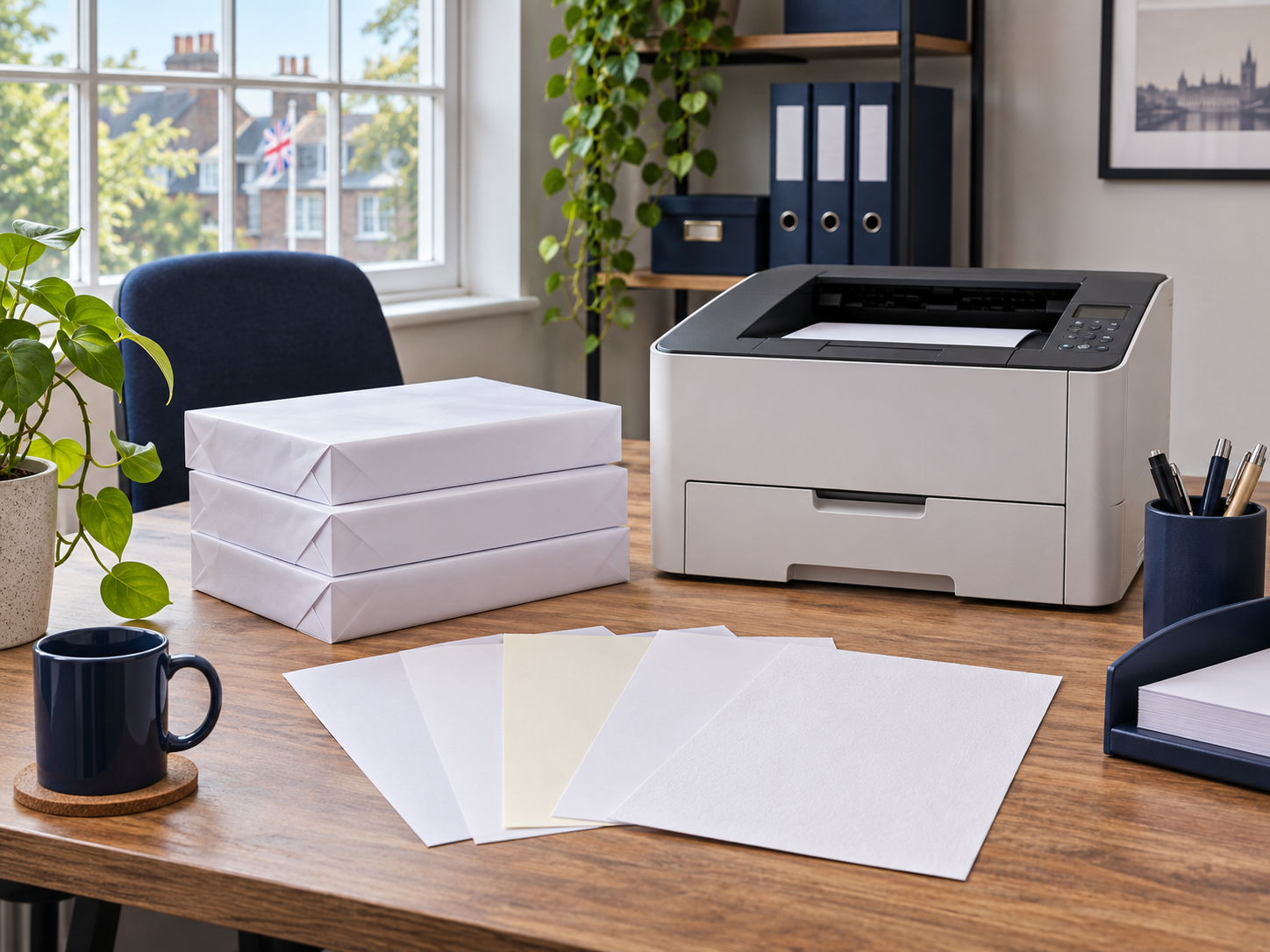
4. Think About Double-Sided Printing
Double-sided printing can reduce the number of sheets used, but the paper still needs to suit the document.
If text or images show through too clearly from the other side, the finished result may be harder to read.
Opacity describes how well paper prevents material on the reverse from showing through. Paper weight can influence the result, but it isn’t the only factor.
For reports or documents with substantial printing on both sides, review the product’s opacity information and test a sample where possible.
A practical check is often more useful than choosing by weight alone.
Print a typical document using your normal settings and assess whether the result is clear enough for its intended purpose.
5. Choose a Finish That Suits the Document
The appearance and feel of the paper can influence how a finished document is received.
For routine office printing, a dependable general-purpose paper may be entirely suitable. A customer proposal or presentation might benefit from a smoother finish or a different specification.
However, a brighter or more expensive paper isn’t necessary for every task.
Consider:
- Whether the document is for internal or external use
- How much colour or image detail it contains
- Whether staff need to write on it
- Whether it will be folded, filed or posted
- How the paper performs with your equipment
The aim is to choose an appropriate finish without adding unnecessary cost to everyday printing.
6. Review Environmental Information Carefully
Businesses looking to make more considered purchasing decisions may wish to review recycled paper options and products carrying recognised sourcing certifications.
Check the specific product information rather than relying on broad descriptions such as “green” or “eco-friendly”.
Useful details to review include:
- The stated recycled content
- Any certification shown on the product
- What that certification covers
- Whether the paper meets your printing requirements
- Available packaging and recycling information
Different claims describe different aspects of a product. Recycled content and responsible fibre sourcing, for example, are separate considerations.
Choosing suitable paper is one part of the picture. Avoiding unnecessary printing and using existing stock sensibly can also help reduce waste.

7. Store Paper Properly
Even suitable paper can become less dependable if it is stored poorly.
Keep supplies in a clean, dry location, protected from damp conditions, excessive heat and physical damage.
Where practical, leave paper in its original wrapping until it is needed and store reams flat.
Avoid placing boxes where they may be exposed to leaks, condensation or frequent knocks.
Follow the paper and equipment manufacturers’ storage guidance, particularly where supplies have been moved between environments with different temperatures or humidity.
A clearly organised storage area also makes it easier to see what is available before placing another order.
8. Buy Quantities Your Workplace Will Use
Buying more paper can reduce the price per ream, but a larger order only offers value if the business will use it and has suitable storage available.
Review normal consumption before committing to bulk quantities.
Consider:
- How much paper your team uses
- Whether demand changes throughout the year
- The space available for storage
- Delivery charges and ordering arrangements
- Any planned changes to printers or working practices
Compare equivalent products by sheet count, size, specification and total delivered cost.
A regular purchasing routine can help maintain stock without allowing unused boxes to accumulate.
A Practical Approach to Workplace Printing Supplies
Choosing printer paper is easier when the purchasing decision starts with the job it needs to do.
Review your equipment’s requirements, identify a suitable everyday option and keep specialist products for the tasks that need them.
At Lomas Office Furniture & Stationery, we supply office paper, ink and toner to businesses across Blackburn and Lancashire.
Whether you need regular paper deliveries or support identifying suitable workplace printing supplies, our team can discuss your requirements and help you explore the available options.
Looking for Printer Paper or Workplace Printing Supplies?
Speak with the Lomas team about the paper sizes, quantities and specifications your business uses, or browse our online office supplies range.