
Smart Office Furniture Solutions: Your Guide to UK Costs for Small Businesses
Setting up a small office always begins with a key question: What’s the real cost of creating a functional, comfortable workspace for your team? This comprehensive guide provides UK-specific, GBP-based cost ranges for essential items and full small-office fit-outs. We’ll break down the main cost drivers and show you how to perfectly balance ergonomics, durability, and affordability, whether you’re buying new or refurbishing.
Many small business owners feel unsure about new vs. refurbished options, hidden fit-out fees, or VAT and delivery charges. This article aims to clear up that uncertainty with straightforward per-employee and per-office estimates, alongside actionable budgeting steps. You’ll discover comparative price bands for desks, chairs, storage, and meeting room furniture, a precise new vs. refurbished analysis, and practical financing and saving strategies specifically for UK operations.
Following our cost guidance, you’ll find a concise, practical note on how local suppliers can turn these estimates into firm quotes and what to expect when you request a consultation, empowering you to move from budgeting to procurement with complete confidence.
Understanding Average Office Furniture Costs for UK Small Businesses
While average costs naturally shift based on quality and the scope of fit-out services, a straightforward way to approach this is through per-employee ranges and example small-office totals. These figures typically cover desks, seating, essential storage, and a compact meeting space.
Per-employee costs generally fall into three distinct categories: ‘Budget’ for core functional items, ‘Standard’ for dependable ergonomics with solid warranties, and ‘Premium’ for top-tier ergonomic and custom-designed pieces. Our ranges factor in the current UK VAT rate, standard UK delivery, and basic installation where specified; bespoke joinery, partitions, or extensive fit-outs would be additional.
Grasping these initial figures is key to setting realistic expectations before you begin gathering quotes and comparing potential suppliers.
To assist your planning, the table below summarises typical per-employee and 5–10 person small-office budgets, broken down by quality tier for quick reference.
These ranges offer illustrative averages that reflect current UK market trends and cover everyday essentials such as desks, task chairs, and basic storage. Up next, we’ll dive into concrete example budgets, demonstrating how individual items combine to form these totals and how installation, delivery, and VAT can adjust your initial estimate.
What’s the Investment for Furnishing Your Small Office?
For a 1–5 person office, the goal is usually to strike a balance between essential ergonomics and a sensible budget. This often means basic desks and task chairs, shared storage, and a compact meeting table. For instance, a sample 3-person starter budget could include three budget desks (£90–£150 each), three standard task chairs (£80–£200 each), a two-drawer filing cabinet (£80–£150), and a small meeting table with chairs (£250–£600), bringing the total to roughly £1,000–£2,000 before VAT and delivery.
Opting for moderate upgrades—like height-adjustable desks or enhanced ergonomic chairs—would shift the same small office into the £3,000–£6,000 bracket, with installation and cable management adding a few hundred pounds more. This small-scale example clearly illustrates how individual item choices contribute to your overall small-office figure, preparing you for per-employee calculations as your team grows.
Grasping how these per-item choices scale is crucial for planning for slightly larger teams, where innovative economies of scale and modular solutions can significantly alter the pricing dynamic.
Exploring Furniture Costs for Your Medium-Sized Office
Medium-sized offices, typically housing 6–20 employees, truly benefit from per-employee scaling. These setups often call for modular benching systems, additional meeting spaces, and more extensive storage, which naturally shifts the cost profile. For 6–20 desks, modular benching or integrated workstations can often reduce individual desk hardware costs, though installation complexity may increase.
You can anticipate per-employee standard budgets ranging from £650 to £1,100, with premium designs, including acoustic screens and bespoke joinery, potentially exceeding £1,500 per person. As layout complexity increases, installation and professional space planning become a larger share of the overall cost for medium-sized fit-outs. When planning, always factor in a contingency and dedicated professional design time to guarantee your layouts perfectly meet workflow and compliance requirements.
Once your layout and workstyle needs are clearly defined, a careful comparison of modular systems versus individual desks, alongside a thorough review of installation costs, will reveal where true economies of scale can deliver significant savings.
Decoding Office Furniture Prices: Type, Quality, and Value
Office furniture prices can vary significantly across categories and quality tiers. Interestingly, you can achieve the same functional outcome at vastly different price points, depending on materials, ergonomic features, and warranty coverage. Generally, desks, chairs, storage, and meeting room items each fall into ‘Budget,’ ‘Standard,’ and ‘Premium’ bands, primarily influenced by frame materials, finishes, and ergonomic capabilities.
Key quality indicators like solid frames, resilient desktop finishes, robust manufacturer warranties, and extensive adjustability will increase the initial investment but consistently lead to a much longer useful lifespan. Below, we offer a focused comparison to help you strategically prioritise where to invest for maximum durability or ergonomics, and where a more budget-conscious approach makes perfect sense.
Keeping these ranges in mind, we recommend strategically choosing upgrades that offer clear, measurable operational value—often in seating and sit-to-stand desks. For other areas, such as simpler storage and reception pieces, a more budget-friendly approach can help you manage overall costs more effectively. Our following subsections will specifically unpack desks and chairs, allowing you to judge where to invest for optimal impact confidently.
Average Desk Prices in the UK: What to Expect
Desks are available in a wide array of basic and specialist designs, with prices reflecting the materials used, adjustment mechanisms, and integrated features like cable management. Simple rectangular desks, ideal for hot-desking or occasional use, typically cost between £75 and £200. While perfectly adequate for low-intensity tasks, they might require earlier replacement.
Sit-stand or electric-adjustable desks, increasingly popular for promoting wellbeing, usually cost between £250 and £650 for dependable models, offering significant ergonomic advantages that can help reduce absenteeism. For executive or bespoke joinery desks, prices can start around £600 and easily exceed £1,200, depending on veneers and custom specifications. We advise prioritising adjustable desks for roles with extensive screen time, and reserving premium fixed desks for managerial or client-facing areas where aesthetics and lasting durability are paramount.
Selecting the ideal desk type is directly linked to your chair choices and your overall ergonomics strategy – a crucial next step in your planning.
Ergonomic vs. Standard Office Chairs: Understanding the Cost Difference
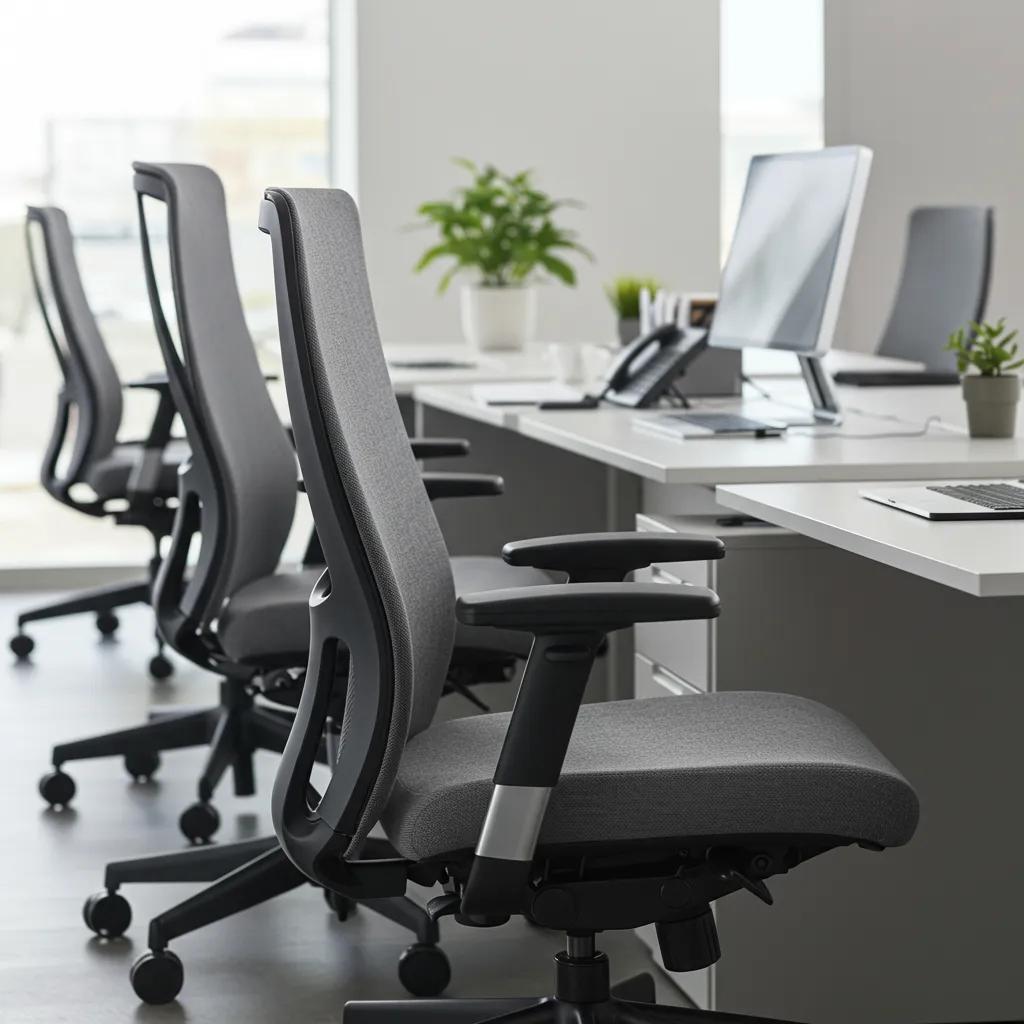
The price distinction between basic task chairs and advanced ergonomic models directly reflects their adjustability, build quality, and warranty duration. Standard task chairs, typically priced between £40 and £120, provide basic support for occasional use, making them a cost-effective choice for short sessions or secondary workstations.
Ergonomic chairs, engineered explicitly for prolonged daily use, generally fall within the £150-£450 range. These provide superior lumbar support, numerous adjustment points, and enhanced materials for sustained comfort. Premium ergonomic chairs, featuring sophisticated mechanisms and extended warranties, can exceed £500.
While a more substantial initial investment, they often deliver significant returns through reduced discomfort and boosted productivity. When assessing value, always consider anticipated daily use, your team’s health priorities, and expected replacement cycles to select the most suitable chair tier.
Strategically balancing your desk and chair investments establishes a crucial ergonomic foundation that will profoundly impact long-term returns and future replacement planning.
Key Factors Influencing Your Small Business Office Furniture Costs
Numerous variables can transform an initial furniture budget into your final project figure. Factors such as customisation, installation, delivery logistics, VAT, warranties, and whether items are new or refurbished all play significant roles. Custom-sized desks, bespoke finishes, and acoustic solutions will naturally add material and labour costs.
Similarly, installation complexity—such as intricate cable routing, building modular bench systems, or fitting partitions—will incur skilled labour charges. UK-specific location and delivery challenges, such as restricted inner-city access, can also increase logistical costs. Grasping these influencing factors empowers small businesses to forecast realistic totals and intelligently select cost-saving strategies without compromising essential ergonomics or compliance.
To help you plan proactively, the table below clearly outlines standard cost drivers and their typical impacts, enabling you to identify potential quote inflators and prepare adequate contingencies.
Understanding these estimated uplifts is invaluable for comparing like-for-like quotations from various suppliers and making informed decisions about when a higher upfront cost translates into superior long-term value. Our next sections will delve into a new vs. refurbished comparison and detail typical additional design and installation fees.
New vs. Refurbished Office Furniture: Understanding the Price Impact
Opting for refurbished or pre-owned furniture can significantly cut your upfront costs, often delivering robust performance for many roles with savings typically ranging from 30% to 60% compared to new items. The main considerations usually involve warranty duration, the condition of the finish, and the level of standardisation—refurbished lines might not offer the precise colour match or extended manufacturer warranty of brand-new products.
For projects with tight deadlines and budgets, refurbished seating and storage are wise, practical choices. However, new ergonomic chairs and adjustable desks are often prioritised to support optimal staff wellbeing. If you choose refurbishment, always ensure your supplier confirms their cleaning and refurbishment standards, along with available aftercare, to manage any long-term risks effectively.
When evaluating your options, it’s crucial to factor in the total lifecycle costs and the potential for future replacements. This naturally leads us to consider the costs of installation and professional design services.
Understanding Additional Costs: Office Design and Installation Services
Professional design and installation services are what transform individual furniture items into a fully functional, inspiring workspace. These services typically encompass CAD planning, expert space optimisation, comprehensive project management, and skilled installation. Professional fees can be structured as fixed amounts or as a percentage of the project, ranging from a few hundred pounds for smaller projects to around 5–15% for larger fit-outs, depending on the scope.
Included services often cover detailed CAD drawings, optimised furniture layouts, precise scheduling, and efficient on-site assembly. Crucially, these services minimise wasted expenditure and prevent costly rework. Investing in professional planning frequently leads to significant long-term savings by ensuring perfectly sized purchases and a seamless installation process. Therefore, it’s wise to view design fees in light of the potential savings from avoiding suboptimal layout decisions.
Viewing installation as a valuable investment, rather than just an expense, helps you strategically decide whether to manage fit-out tasks internally or outsource them, ultimately informing smarter budgeting choices for your small business.
Smart Strategies: Budgeting and Saving on Office Furniture for Small Businesses
Effective budgeting for your office furniture requires a clear needs assessment, strategic, staged purchasing, and the wise utilisation of cost-saving avenues such as refurbished items or vendor finance. Begin by prioritising ergonomic essentials—your desk and chair—before planning secondary items such as storage and reception furniture.
Phasing purchases across financial quarters, negotiating bulk discounts, and exploring quality refurbished stock are all practical steps that can significantly reduce initial capital outlay while maintaining full functionality. Here are five immediately actionable tips to help you create a sensible furniture budget that perfectly aligns with your small business’s cash flow.
- Evaluate roles and daily hours to prioritise ergonomic solutions for your most frequent users.
- Explore phased purchasing to spread costs across multiple financial periods intelligently.
- Leverage verified refurbished items for non-critical furniture to reduce capital expenditure significantly.
- Always negotiate bulk discounts and request comprehensive, bundled installation quotes.
- Allocate a 10–15% contingency for VAT, delivery, and any minor unforeseen adjustments.
These five essential steps offer a practical checklist, transforming your high-level budget into a robust purchase plan that effectively mitigates risk and maintains tight control over your spending. Our next subsection will detail common financing options and explain when each is most appropriate for UK small businesses.
Crafting an Effective Office Furniture Budget for Your Small Business
An adequate budget starts with a comprehensive needs matrix: meticulously map out staff roles, their daily desk hours, and essential equipment per person. Then, apply our per-employee cost bands to establish a solid baseline. Prioritise allocating funds to ergonomic seating and adjustable desks for high-use roles, always setting aside a contingency for installation and VAT.
Suppose cash flow is a concern, plan for phased purchases. Use your matrix to test various scenarios (e.g., upgrading chairs over 3 years versus replacing desks sooner) and compare the total cost of ownership, not just the upfront price. This structured methodology ensures your budget accurately reflects genuine workplace needs and provides a well-justified buying plan for all stakeholders.
With a clear budget matrix in place, the next logical step is to explore financing options that perfectly align your purchase timing with available funds – a topic we’ll cover next.
Exploring UK Financing Options for Your Office Furniture
Small businesses in the UK have access to a range of financing solutions to spread the cost of furniture, including vendor finance, leasing, hire purchase, and flexible short-term payment plans, each with its own distinct advantages and considerations. Leasing helps preserve cash flow and can often include maintenance, though it might prove more costly over the long term compared to an outright purchase.
Hire purchase, on the other hand, transfers ownership at the end of the payment term and is ideal for businesses that prefer fixed monthly costs. Vendor finance or staged payment plans can streamline procurement with predictable monthly fees and often simpler credit checks for smaller transactions. When evaluating finance, always compare the total repayment cost, tax implications, and any maintenance inclusions to select the option that best aligns with your cashflow and long-term asset strategy.
To put this into perspective: spreading a £6,000 standard small-office purchase over 36 months results in a modest monthly outlay, effectively preserving your working capital for crucial growth or operational needs.
Lomas Office Furniture: Your Partner for Affordable Small Business Solutions
Lomas Office Furniture stands as a leading UK-based e-commerce, information, and solutions hub, dedicated to supporting businesses with a comprehensive blend of supply, design, and installation services, all meticulously tailored to small-business budgets. We proudly offer free, no-obligation consultations with our expert office design team, utilising advanced CAD and space-planning software to transform your budget goals into practical layouts and precise, itemised quotes.
Lomas Office offers both new and high-quality refurbished furniture, empowering our clients to manage upfront costs effectively without compromising on quality standards. We also pride ourselves on competitive pricing and, where stock and location allow, next-day delivery.
Our skilled installation teams expertly manage on-site assembly and cable management, significantly reducing project risk. Ultimately, Lomas positions its services to streamline procurement for small operators seeking predictable costs and exceptional value.
These core service elements—expert consultation, precise CAD planning, flexible refurbished options, and seamless installation—are specifically designed to shorten your procurement cycles. They effectively translate the per-employee budget ranges we’ve discussed into firm, transparent quotations that fully account for practical considerations like VAT, delivery, and professional installation.
Our Comprehensive Office Design and Refurbishment Services at Lomas
Lomas delivers a comprehensive suite of services, ideally suited for both small and larger projects. This includes CAD-led space planning, complete fit-out and refurbishment services, the supply of individual furniture lines and stationery, alongside expert installation. Our CAD planning is instrumental in helping you visualise layouts, optimise desk orientation, and ensure compliant spacing well before any purchase commitments are made.
Our refurbished furniture selections provide excellent, cost-effective alternatives to new stock for secondary items or bulk orders. Meanwhile, our full-fit options seamlessly combine supply and installation into one expertly managed project. Our free consultations are the ideal starting point for businesses seeking a realistic, itemised quote tailored to their space and budget.
Presenting our services in this clear, practical manner ensures buyers fully understand what’s included in their quote and precisely which features will influence their final costs.
Our Commitment: Competitive Pricing and Unwavering Customer Satisfaction at Lomas
Lomas actively minimises customer risk through innovative, competitive sourcing practices, offering quality refurbished options to reduce capital costs significantly, and providing next-day delivery for in-stock items whenever possible. We combine our competitive procurement with a highly skilled installation team, ensuring every item is fitted correctly and with minimal disruption.
Our CAD-driven planning further reduces the chance of ordering errors. During consultations, we openly discuss aftercare policies and warranty clarifications, so buyers have a complete understanding of their post-sale support. To request a budget-aligned quote or to book your free, no-obligation consultation, contact Lomas today for a tailored estimate based on your specific office footprint and desired quality tier.
These clear points illustrate precisely how a trusted supplier transforms initial budget ranges into a practical project plan and a formal, transparent quote, seamlessly bridging the gap between your planning and successful procurement.
The Long-Term Advantage: Investing in Quality and Ergonomic Office Furniture
Investing wisely in ergonomic and durable office furniture delivers tangible, measurable returns over time. You’ll see improved productivity, reduced absenteeism, and fewer replacements. Ergonomic chairs and adjustable desks are proven to alleviate musculoskeletal complaints, significantly boosting concentration and output for staff who spend extended periods at screens.
Furthermore, durable materials and sustainable sourcing practices extend the useful life of your furniture, thereby reducing the total cost of ownership and minimising disruptive replacements. By framing purchases as strategic lifecycle investments, rather than mere one-off expenses, it becomes far easier to justify modest upfront premiums for items that provide multi-year benefits.
The following benefits are central to a lifecycle-focused procurement strategy and help justify higher initial spend where appropriate.
- Enhanced productivity stemming from reduced discomfort and improved posture.
- Significantly lower long-term replacement costs, thanks to durable materials and robust warranties.
- Stronger sustainability credentials, aligning with modern procurement policies and boosting your reputational value.
Boosting Wellbeing and Productivity with Ergonomic Furniture
Ergonomic furniture significantly enhances productivity by promoting neutral posture, reducing physical strain, and enabling sustained focus. Key mechanisms include superior lumbar support, adjustable seat height, and sit-stand flexibility, all designed to mitigate the adverse effects of prolonged static postures.
These thoughtful features actively reduce the incidence of back and neck discomfort—common issues that interrupt work and contribute to short-term absences. Moreover, comprehensive adjustability ensures comfort for a diverse range of body sizes and working styles. Prioritising ergonomic chairs and height-adjustable desks for roles involving extensive use delivers the most direct and impactful health and productivity gains. By selecting items with precise adjustability and dependable warranties, you transform ergonomic principles into tangible workplace resilience and reduced downtime.
Recognising ergonomics as a vital investment in your human capital directly informs strategic budget allocation decisions during the initial procurement phase.
The Smart Choice: Durable and Sustainable Furniture for Long-Term Value
While durable, sustainably sourced furniture may involve a higher initial investment, it consistently delivers lower lifecycle costs through reduced maintenance, fewer replacements, and valuable recycling or refurbishment pathways. A thorough lifecycle comparison frequently demonstrates that investing a premium in robust frames and replaceable components significantly reduces your total expenditure over several years.
Furthermore, sustainable sourcing can perfectly align with your corporate responsibility goals or procurement policies. Maintenance-friendly designs and modular components enable partial replacement rather than complete item disposal, further controlling long-term costs. By combining durability with innovative refurbishment options, you extend asset life and actively support the circular-economy approaches that many forward-thinking businesses now champion.
Adopting a comprehensive lifecycle perspective when budgeting empowers small businesses to make procurement choices that not only minimise cost per year of use but also strongly support their sustainability objectives.
Ready for your next practical step? We invite you to request a free, no-obligation consultation. Let us help you transform these per-employee ranges into a precise, itemised quote, and explore the perfect blend of new and refurbished options that meet both your budget and ergonomic priorities.
Your Questions Answered: Frequently Asked Questions
1. What are the key benefits of choosing refurbished office furniture?
Refurbished office furniture offers substantial cost savings, typically 30% to 60% less than brand-new items. This smart option enables small businesses to furnish their workspaces effectively without sacrificing quality. Our refurbished pieces consistently deliver robust performance and maintain excellent aesthetic appeal, making them ideal for a wide array of roles.
Furthermore, choosing refurbished furniture is a highly environmentally conscious decision that actively promotes recycling and reduces waste. However, it’s always crucial to verify the refurbishment standards and available warranty options to ensure your long-term satisfaction and reliability.
2. How can small businesses effectively assess their specific office furniture needs?
To accurately assess your office furniture needs, we recommend that small businesses begin by meticulously mapping out staff roles and their unique requirements. This involves evaluating the daily hours each employee spends at their desk and pinpointing the essential equipment for their tasks.
Developing a comprehensive ‘needs matrix’ is invaluable for prioritising ergonomic essentials, such as high-quality chairs and desks, before moving on to secondary items like storage. This structured methodology ensures your budget perfectly aligns with your actual workplace demands, leading to informed purchasing decisions that significantly enhance both productivity and comfort.
3. What financing options are available for small businesses investing in office furniture?
Small businesses across the UK can access various financing options for office furniture, including vendor finance, leasing, hire purchase, and flexible short-term payment plans, each with its own distinct advantages and considerations. Vendor finance offers the benefit of predictable monthly payments, while leasing can often include maintenance, though it might prove more costly over the long term than an outright purchase.
Hire purchase, on the other hand, transfers ownership at the conclusion of the payment term and is ideal for businesses that favour fixed monthly costs. Each option has its own advantages and considerations, so it’s vital to thoroughly compare total costs and tax implications to find the ideal fit for your cash flow and long-term strategic goals.
4. How do professional installation and design services influence overall office furniture costs?
Professional installation and design services can indeed significantly impact the total cost of your office furniture project. Expert design services, including precise CAD planning and intelligent space optimisation, are crucial to ensuring your layout perfectly meets workflow and compliance needs, often leading to considerable long-term cost savings.
The complexity of installation, particularly when skilled labour is required for assembling modular systems or intricate wiring, can add substantial charges. By understanding these key factors, businesses can budget more effectively and make well-informed decisions about whether to outsource or manage installations internally.
5. What are the essential considerations for small businesses when budgeting for office furniture?
When developing your office furniture budget, small businesses should always begin with a clear, comprehensive needs assessment, prioritising ergonomic essentials such as high-quality desks and chairs. We strongly advise planning for phased purchasing to spread costs over time intelligently, and always include a contingency for VAT, delivery, and any unforeseen expenses.
Exploring our refurbished options can also be a smart way to reduce initial capital outlay significantly. Furthermore, negotiating bulk discounts and carefully considering available financing options can optimise your budget management, ensuring your office setup aligns perfectly with both your functional requirements and financial constraints.
6. How does ergonomic furniture significantly enhance employee wellbeing?
Ergonomic furniture plays an absolutely crucial role in significantly enhancing employee well-being by actively promoting proper posture and effectively reducing physical strain. Key features like superior lumbar support, adjustable seat heights, and sit-stand capabilities are designed to mitigate the discomfort commonly associated with prolonged sitting.
By strategically investing in ergonomic solutions, businesses can effectively reduce absenteeism and notably improve overall productivity, as employees are far less likely to experience pain or fatigue. Prioritising ergonomic furniture is more than just a health investment; it actively cultivates a more engaged, comfortable, and ultimately, more efficient workforce.
7. What are the long-term advantages of a strategic investment in quality office furniture?
A strategic investment in quality office furniture delivers substantial long-term benefits, including enhanced productivity, reduced absenteeism, and significantly lower replacement costs. Durable and ergonomic furniture directly improves employee comfort, which in turn leads to better focus and increased output.
Furthermore, high-quality materials frequently come with extended warranties, further reducing your long-term expenses. By viewing furniture purchases as smart lifecycle investments rather than one-off costs, businesses can confidently justify higher initial expenditures for items that deliver sustained value and actively support a healthier, more productive work environment.