The Complete Guide to Buying Office Furniture

The Complete Guide to Buying Office Furniture

Office furniture affects far more than the appearance of a workplace.

It determines how comfortably employees can work, how efficiently the available space is used and whether the office can adapt as the business changes. It also influences storage, collaboration, visitor experience and the impression the organisation creates.

This makes furniture a business investment rather than a collection of individual purchases.

A desk that appears inexpensive may waste valuable floor space. A chair described as ergonomic may not adjust sufficiently for the person using it. Storage purchased without a clear plan can make an office feel more cluttered rather than better organised.

The strongest furniture projects begin by understanding the workplace.

What do employees need to do? How many people use the office each day? Which areas are under pressure? What is likely to change during the expected life of the furniture?

Once these questions have been answered, products can be selected with a purpose.
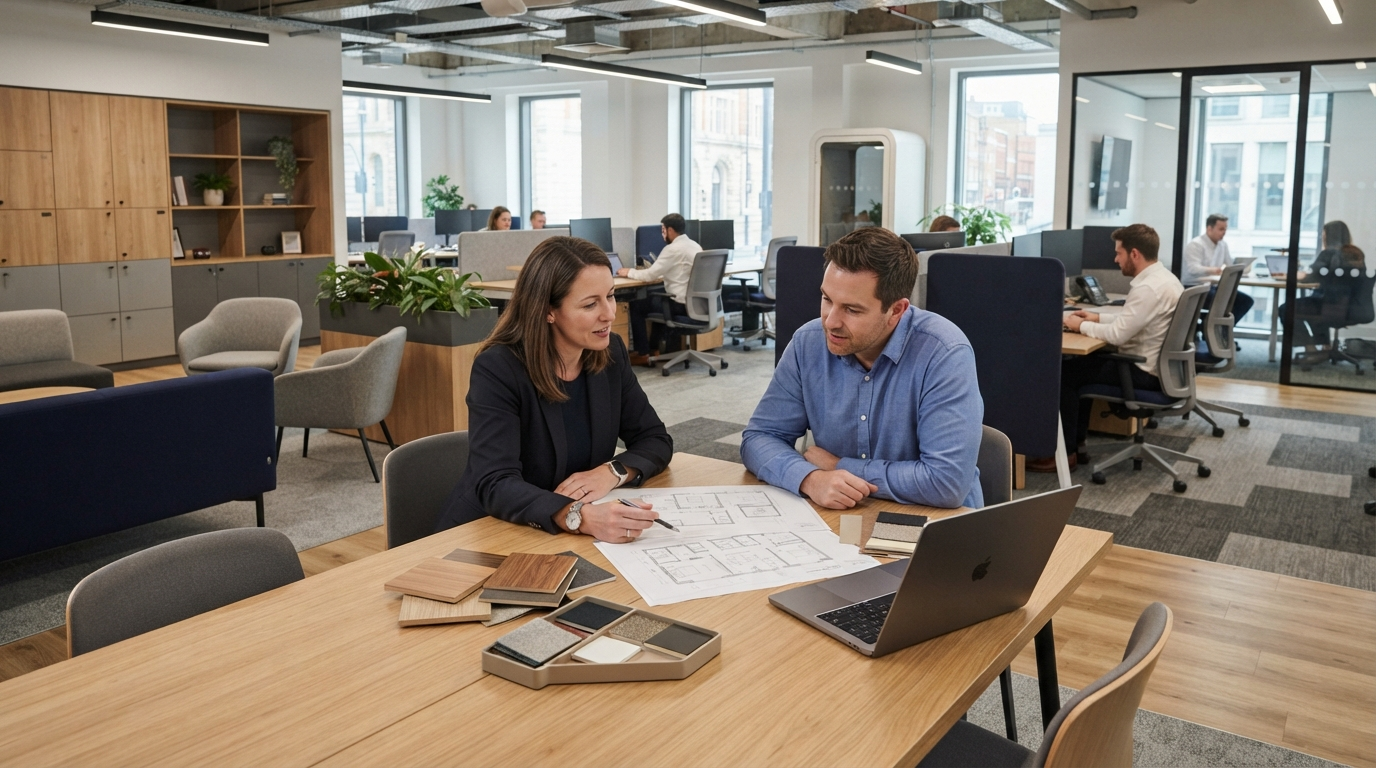
Begin With the Workplace

Furniture should be planned around the business rather than asking the business to adapt around the furniture.

Start by reviewing how the office currently works.

Look at which areas are consistently busy and which remain empty. Consider where employees hold conversations, store equipment and complete focused tasks. Review whether teams that communicate frequently are positioned near each other.

The condition of the existing furniture should also be assessed. Some items may remain perfectly suitable, while others may be worn, poorly sized or incapable of supporting modern equipment.

Employee feedback can reveal practical problems that are not immediately visible. Chairs may be difficult to adjust, desks may lack cable management and meeting rooms may not provide convenient access to power.

This assessment helps distinguish genuine furniture requirements from assumptions.

The business may believe it needs more desks when the real problem is an inefficient layout. It may plan additional storage without first reviewing what is being retained.

Buying furniture before understanding the workplace can make existing problems more expensive and permanent.

Define What the Project Needs to Achieve

“Replace the office furniture” is not a complete brief.

The business should define why the furniture is being replaced and what should improve as a result.

The project may need to accommodate a growing team, support hybrid working or make better use of a restricted floor area. It may aim to improve employee comfort, create more effective meeting spaces or present a more professional image to visitors.

There may be several objectives, but they should be prioritised.

A project focused on space efficiency may favour appropriately sized desks and integrated storage. One intended to support recruitment and retention may place greater emphasis on employee experience, furniture adjustment and workplace choice.

Budget, programme and future growth should be documented early. These constraints influence the products, layout and delivery approach.

A clear brief makes quotations easier to compare because every supplier is responding to the same requirements.

Plan the Space Before Selecting Products

Furniture dimensions determine how a workplace functions.

A desk that is slightly wider or deeper can make a significant difference when repeated across an entire office. Armrests affect whether chairs can approach the work surface, while storage units change circulation and sightlines.

Space planning tests these relationships before anything is ordered.

It considers the number and location of workstations, meeting spaces, storage, reception and collaborative areas. It also accounts for circulation, power, data and the relationship between noisy and quiet activities.

The goal should not be to fit the largest possible number of desks into the available floor area. Employees need enough room to work comfortably and move safely.

Meeting rooms must be assessed in use, not only by whether a table physically fits. Chairs need room to be pulled away, and participants should be able to move around the table.

A professional space plan allows furniture quantities and dimensions to be confirmed before the business commits to a purchase.

The Complete Guide to Buying Office Furniture

Setting a Realistic Budget

Office furniture costs depend on the number of employees, the product specification and the different areas included in the project.

A workplace requiring only desks and task chairs will cost less than one that also needs storage, meeting rooms, reception furniture and collaborative spaces.

The business should separate essential requirements from desirable additions.

Furniture used intensively every day normally deserves priority. Suitable task chairs and practical workstations may provide greater value than spending heavily on decorative furniture in areas used occasionally.

Delivery, assembly and installation should be included in the budget. Space planning, furniture removal and adjustments to power or data may create additional costs.

A contingency can provide flexibility when requirements change or issues become apparent during installation.

The lowest quotation is not automatically the least expensive option over time. Product lifespan, warranties, replacement parts and aftercare influence the real cost of ownership.

Quotations should be compared on a like-for-like basis. A proposal that includes professional installation and a stronger specification cannot be assessed fairly against a supply-only price for lighter-use furniture.

Office Desks and Workstations

The right desk depends on the employee, their equipment and the tasks they perform.

An employee using a laptop and limited paperwork may need less surface area than someone working with multiple monitors, technical drawings or specialist equipment.

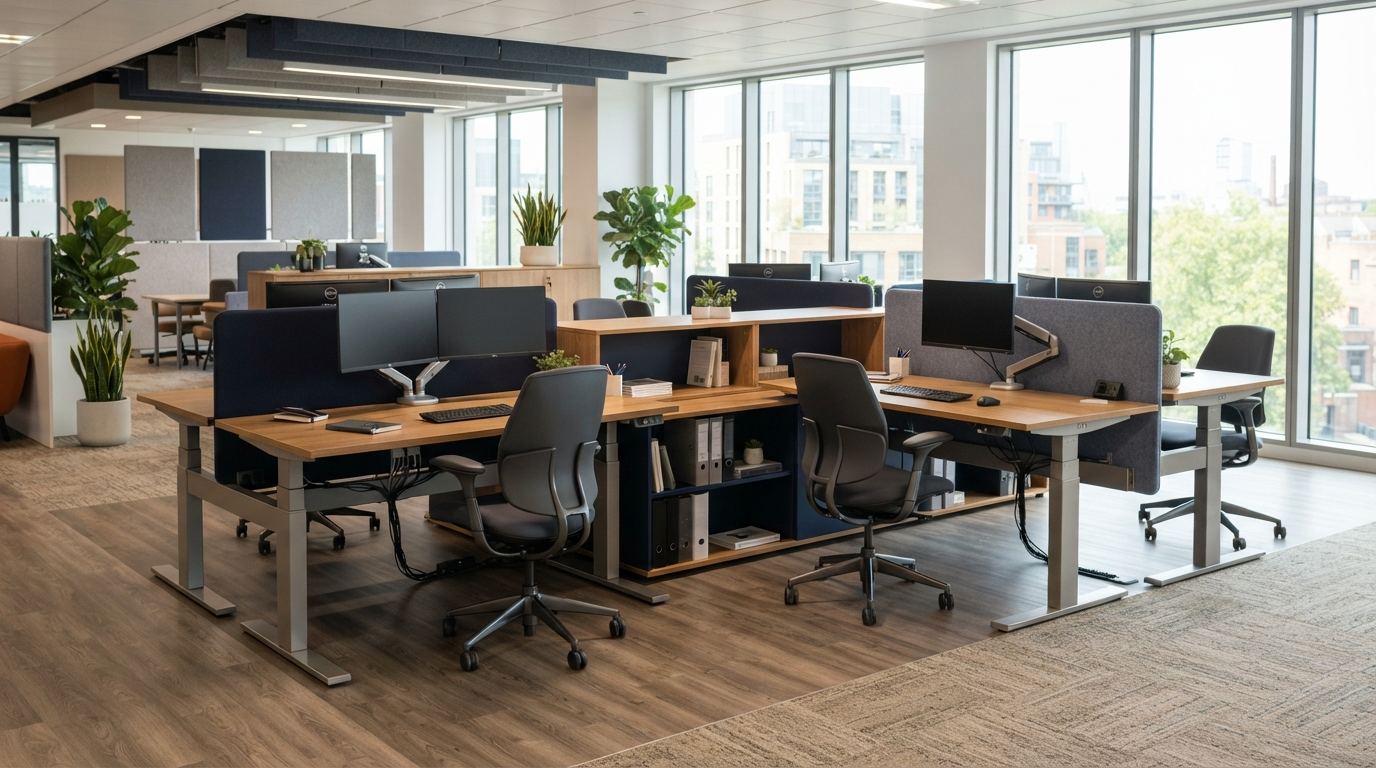
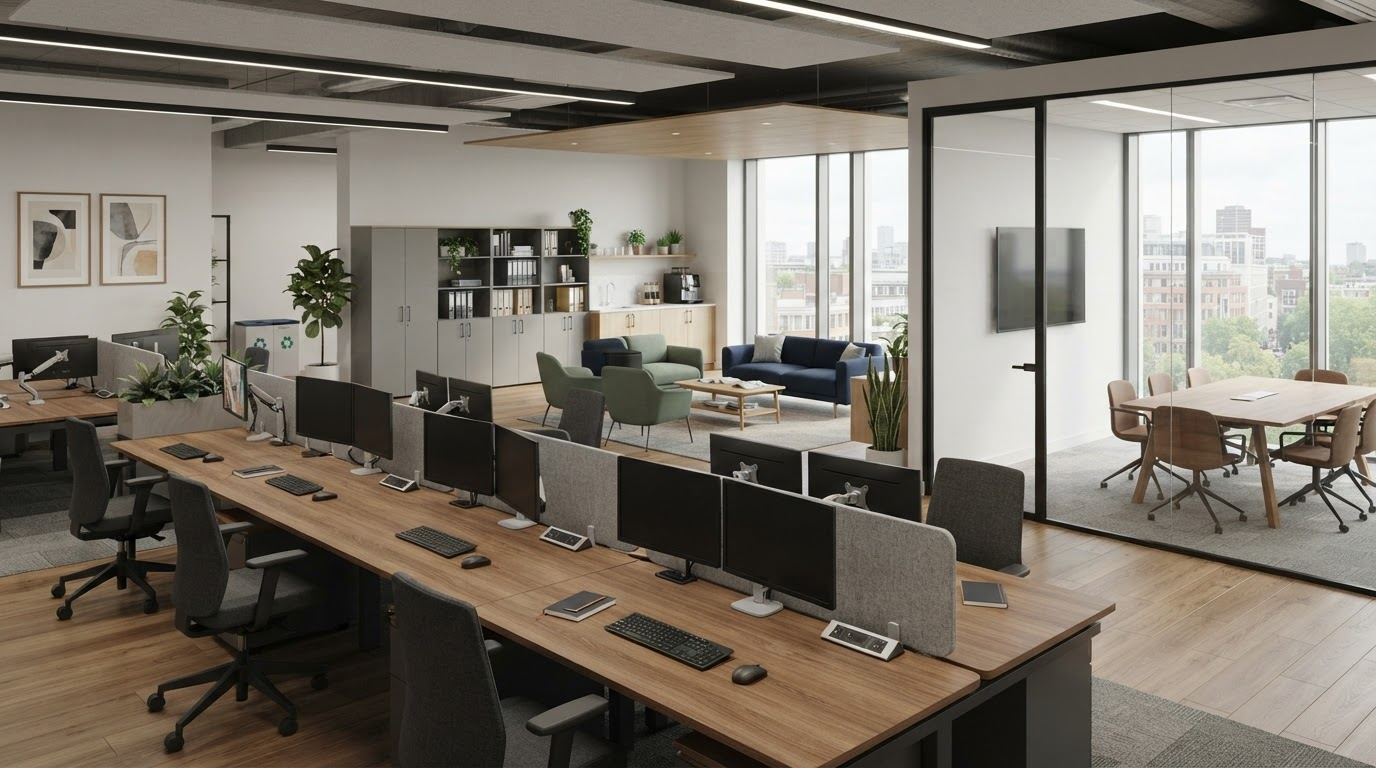
Straight desks remain a practical option for many workplaces. Bench systems can create an efficient and coordinated layout for larger teams. Individual freestanding desks may provide greater flexibility in smaller offices or rooms with awkward dimensions.

The work surface must provide enough usable area without consuming unnecessary floor space.

Cable management should be considered during selection. Loose power and data cables create clutter and make future changes more difficult. Desk-level power can be valuable where employees regularly connect laptops or other devices.

Screens may provide visual separation and absorb some sound, but their height and positioning should reflect the task. Excessively high screens can make teams feel disconnected, while very low screens may offer little practical benefit.

The desk needs to work with the chair, equipment, power and wider layout. It should never be selected in isolation.

Fixed Desks or Bench Systems?

Fixed individual desks and bench systems each have advantages.

Individual desks can be moved or replaced more easily and may suit private offices, small teams or spaces with irregular dimensions.

Bench systems create a consistent appearance and can use space efficiently. They may also simplify power and cable management across groups of workstations.

However, a long bench can become difficult to reconfigure when teams change. It may also encourage employees to add personal barriers when they need greater privacy or control over noise.

The decision should reflect how often the layout is expected to change, how closely teams work together and the services required at each position.

A product described as flexible is only useful when the business can reconfigure it practically.

The Complete Guide to Buying Office Furniture

Height-Adjustable Desks

Height-adjustable desks allow employees to alternate between sitting and standing.

They can be valuable for individuals who prefer to change position during the day, but they should not be treated as a requirement for every workplace or a reason to stand continuously.

The desk must provide a suitable height range for the intended user. The mechanism should operate smoothly and accommodate the equipment placed on the work surface.

Power and cable management become particularly important because cables need enough movement without becoming trapped or stretched.

Where height-adjustable desks are shared, controls should be simple to use. Employees are unlikely to adjust equipment that appears complicated or time-consuming.

The additional cost should be considered against expected use. A feature provides little value if nobody understands it or feels able to use it.

Choosing Office Chairs

A chair should be selected around the person, the workstation and the amount of time it will be used.

A chair intended for occasional meetings does not require the same specification as one used throughout the working day.

Task chairs should offer useful adjustment. Seat height is essential, while seat depth, lumbar support, armrests and movement mechanisms can help accommodate a broader range of users.

The word “ergonomic” should not be accepted as proof of suitability. A chair can have numerous controls and still be wrong for the user.

The adjustment range, seat dimensions and relationship with the desk all need to be considered. Armrests that collide with the work surface may cause the employee to sit too far away.

Employees should be shown how to use the chair. An adjustable product provides little benefit when it remains in the position set during installation.

Where possible, chairs should be tested before a large order is placed.

Shared Seating and Hot-Desking

Shared workstations require chairs that can be adjusted quickly and easily.

A chair that works perfectly for one dedicated user may not accommodate the range of employees using a hybrid workplace.

Controls should be visible and intuitive. A short adjustment guide can help employees establish a suitable working position at the start of the day.

Consistency can also help. When the same chair model is used across shared workstations, employees only need to understand one set of controls.

This does not mean a single chair will suit everyone. Businesses should retain alternative options for employees with different dimensions, mobility needs or specialist requirements.

Shared furniture should support flexibility without ignoring the individual.

Office Storage

Storage should be planned around what the business genuinely needs to keep.

Adding cupboards without reviewing their contents often preserves clutter and reduces usable floor space.

Begin by identifying personal, departmental and secure storage requirements. Paper records, office supplies, equipment and employee belongings may each need a different solution.

Personal lockers can support hybrid workplaces where employees do not have dedicated desks. Shared cupboards may work better than individual pedestals when teams use common documents or supplies.

Tall storage increases capacity without using substantially more floor area, but it can block daylight and create enclosed routes if positioned poorly.

Lower storage units can help define zones while maintaining visibility across the office.

Storage should be convenient for the people who use it. A well-organised system reduces unnecessary movement and prevents work surfaces from becoming permanent storage areas.

The Complete Guide to Buying Office Furniture

Meeting Tables and Chairs

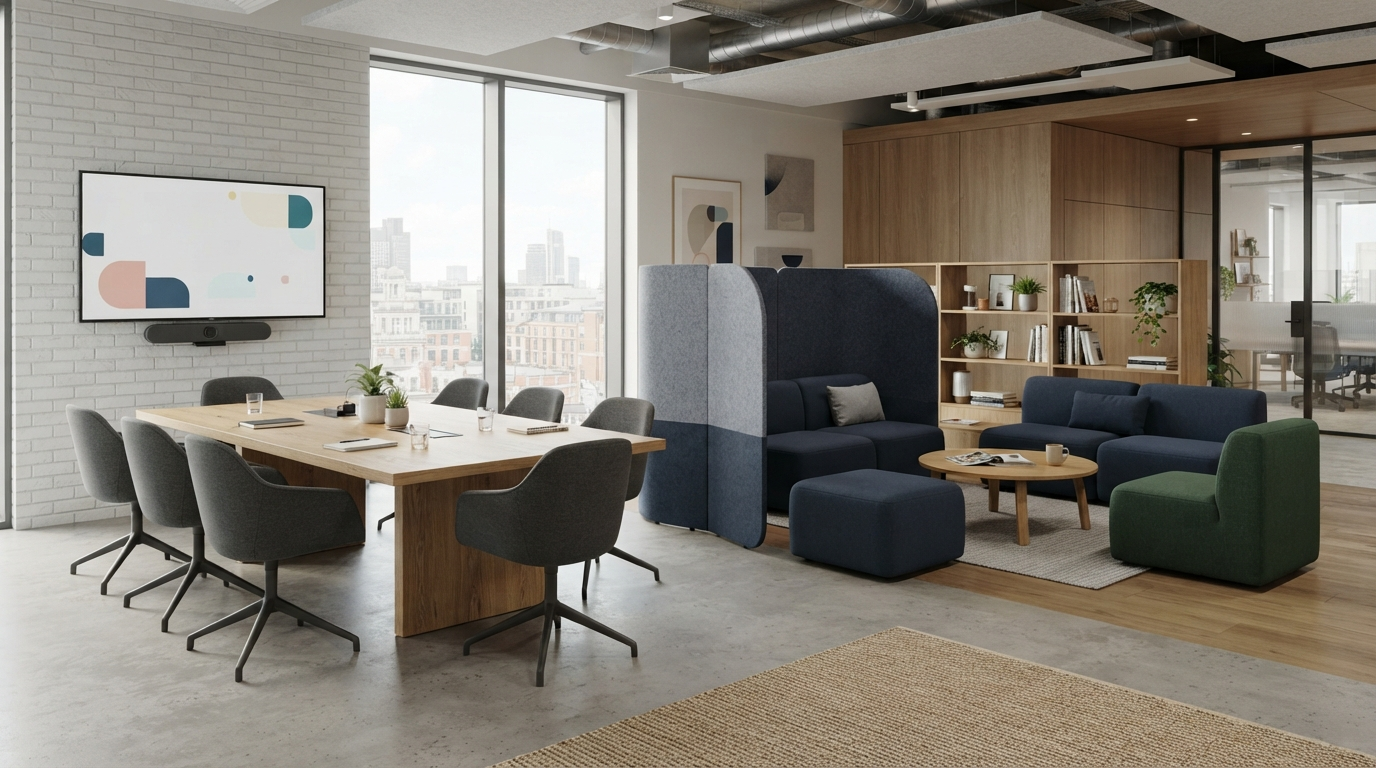
Meeting furniture should be selected according to the room’s normal use.

A table should accommodate the typical number of participants rather than the largest group that might meet once a year. Oversized tables consume valuable space and can make smaller meetings feel unnecessarily formal.

Participants need enough room to sit, move and view screens comfortably. Table legs, bases and integrated power modules should not restrict the seating positions.

Meeting chairs should reflect how long people normally remain seated. A simple conference chair may be suitable for short discussions, while longer meetings require greater support.

Stacking or folding furniture can make a room more flexible, but it must be easy to store and reconfigure. Furniture that is theoretically movable but rarely changed provides little practical benefit.

Technology, lighting and acoustics should be coordinated with the furniture from the beginning.

Boardroom Furniture

A boardroom often supports management meetings, presentations, interviews and important client conversations.

The furniture should create an appropriate impression while remaining practical.

Every participant should have a clear view of other people and presentation screens. Power and connectivity should be available without cables dominating the table.

Boardroom chairs need to remain comfortable during longer meetings. Their dimensions also affect how many people can sit around the table without feeling crowded.

A large boardroom can become an inefficient use of space when it remains empty for much of the week. Flexible tables may allow the room to support training and workshops, provided they can be reconfigured safely and easily.

Appearance matters, but it should not come at the expense of visibility, movement or everyday operation.

Reception Furniture

Reception furniture influences a visitor’s first impression of the business.

The area may require a reception desk, visitor seating, occasional tables and practical storage. The correct combination depends on how visitors arrive and how long they normally wait.

A large desk is not always necessary. A compact reception point may provide a more welcoming experience and release space for comfortable seating.

The person using the desk needs appropriate work surfaces, storage and access to technology. Visitor information and computer screens may require visual privacy.

Reception furniture should connect with the wider workplace rather than appearing as a separate showroom.

A modest area can still feel professional when it is carefully planned and uncluttered.

Collaborative and Breakout Furniture

Collaborative furniture can support short conversations, project work and less formal meetings.

It may include modular seating, high tables, project benches, acoustic booths and media units.

A sofa placed in an empty corner does not automatically become a useful collaboration area. Employees may also need an appropriate table, access to power and some separation from surrounding workstations.

Very low furniture may be comfortable for a short conversation but unsuitable for detailed laptop work. High tables may support brief catch-ups but not longer planning sessions.

The products should be selected according to a defined activity.

Collaborative areas also generate noise. Their position and acoustic treatment must be considered so they do not make focused work more difficult elsewhere.

Furniture supports collaboration, but it cannot create a collaborative culture by itself.

The Complete Guide to Buying Office Furniture

Reusing Existing Furniture

Existing furniture does not need to be replaced simply because the office is changing.

Desks, cupboards and meeting furniture may remain suitable for years when they are in good condition and compatible with the proposed layout.

Reusing products can reduce costs and waste.

However, retaining every item can compromise the project. Oversized desks, mismatched storage or worn seating may prevent the workplace from achieving its objectives.

Each item should be assessed according to condition, suitability and how well it works with the new furniture.

Dimensions and finishes should be recorded during planning. Assuming an existing product will fit can create problems during installation.

The decision should be based on future usefulness rather than the fact that the item has already been paid for.

Quality and Durability

Commercial office furniture is used repeatedly and should be specified accordingly.

A product suitable for occasional domestic use may not withstand the demands of a busy workplace.

Desk frames should remain stable, mechanisms should operate reliably and surfaces should tolerate normal equipment and cleaning. Chair controls and moving components need to withstand frequent adjustment.

Fabric and finishes should reflect the environment. Shared and high-traffic areas may require materials that are particularly durable and easy to maintain.

Quality is not always visible in a product image. Construction, specification, warranty and supplier support provide a better indication of how the furniture is likely to perform.

Paying more does not automatically guarantee better value. The strongest choice is the product that provides the required performance over its expected life without unnecessary features.

Warranties and Aftercare

A warranty should be considered alongside the product’s intended use.

Check how long the cover lasts, which components are included and whether the usage conditions match the workplace.

A long warranty may provide reassurance, but it does not replace a proper assessment of quality and suitability.

Replacement parts can extend the useful life of furniture. Being able to replace a chair castor, arm pad or gas lift may prevent the entire product from being discarded.

Aftercare also matters when furniture needs to be adjusted, moved or expanded. A supplier familiar with the original project can help maintain consistency as the business changes.

The cheapest product becomes poor value when it cannot be maintained or matched a short time later.

Sustainability

Sustainable furniture purchasing begins with avoiding unnecessary products.

Businesses should assess what can be reused, repaired or reconfigured before ordering replacements.

New furniture should be durable and appropriate for its intended use. A product that lasts longer and can be maintained may provide better environmental value than one selected primarily for a sustainability label.

Materials, manufacturing and end-of-life options can also inform the decision. However, these considerations should be reviewed alongside the product’s complete lifespan.

Modular furniture can adapt as the organisation changes, reducing the need for wholesale replacement. Standard finishes may be easier to match during future expansion.

Responsible removal should be planned for furniture that cannot be retained. Depending on its condition, it may be reused, donated or recycled rather than sent directly to disposal.

Style, Colour and Brand

Furniture should reflect the organisation without becoming excessively trend-led.

Colour, materials and finishes can create a consistent workplace and reinforce the desired atmosphere.

A professional services business may prefer calm, understated finishes. A creative or education-focused organisation may choose more colour and visible collaborative areas.

The office should still feel credible several years after completion.

Timeless core furniture can be combined with fabrics, paint and accessories that are easier to update. This helps the workplace evolve without requiring every product to be replaced.

Consistency does not mean every item must look identical. Different spaces can have their own character while remaining visibly connected.

Planning for Future Change

The furniture should support the expected direction of the business.

This may involve growth, hybrid working or changes to team structures. The plan should be flexible enough to respond without being designed around every imaginable scenario.

Modular desks and storage can make later changes easier. Accessible power and cable management reduce the disruption involved in moving workstations.

Standard product ranges can simplify future orders, although businesses should consider whether finishes and components are likely to remain available.

Furniture that only works in one specific arrangement can become restrictive as the organisation evolves.

Flexibility should remain practical. A desk described as mobile or modular offers little value if reconfiguration requires specialist labour every time.

Delivery and Installation

Furniture delivery should be planned as part of the project rather than treated as the final administrative step.

Building access, parking, lifts, staircases and delivery times can all affect the installation.

Existing furniture may need to be removed before new products arrive. Flooring, decoration, power and data work must be completed in the correct sequence.

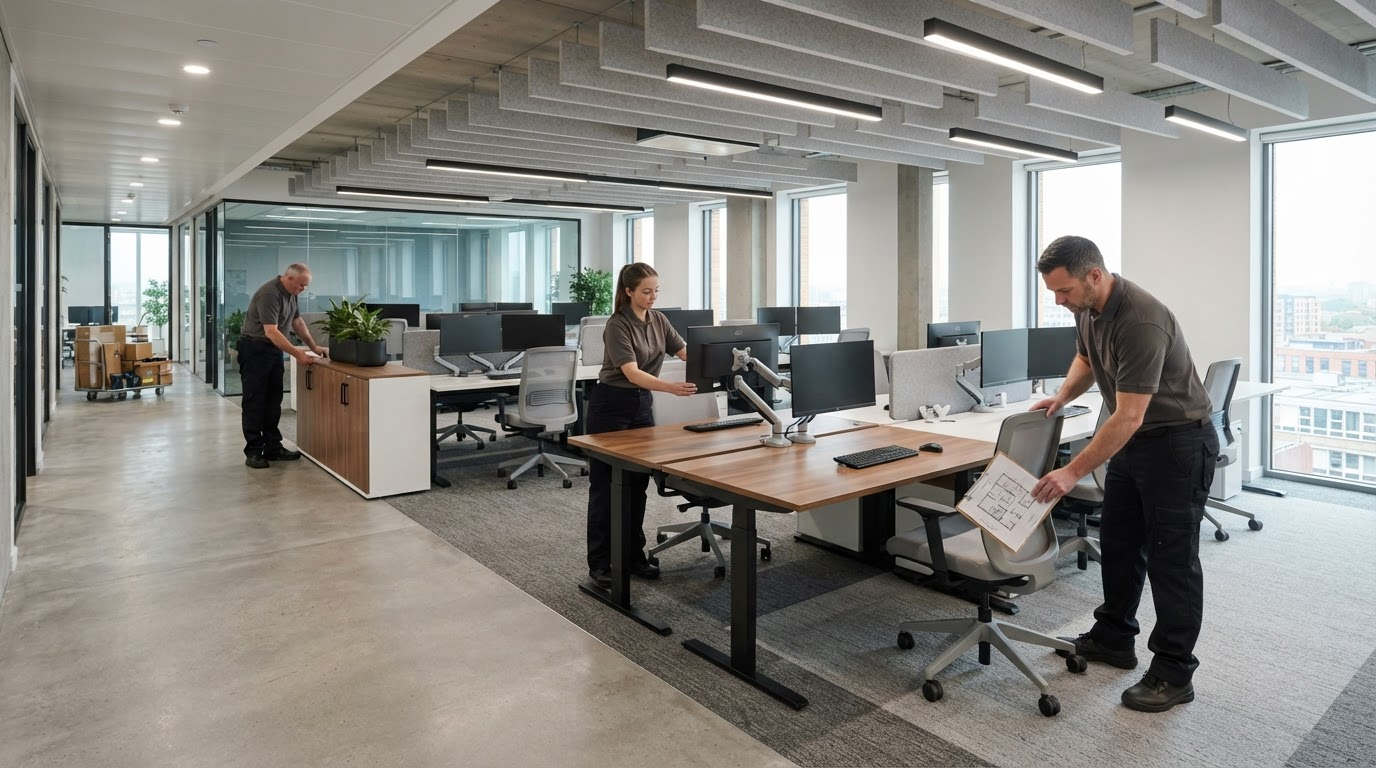
Professional installation helps ensure furniture is assembled correctly and positioned according to the agreed plan. Packaging can also be removed systematically.

For larger projects, installation may be phased to reduce disruption. Employees might move between areas as each section is completed.

The programme should allow time for products to be checked and adjusted before employees begin using the workplace.

Furniture Installation and Employee Handover

Installation is not complete when the final desk has been assembled.

Chairs may need to be adjusted for individual users. Employees should understand how to operate sit-stand desks, shared storage and flexible meeting furniture.

Technology and desk-level power should be tested. Cable management should remain tidy after equipment is connected.

Employees need to know where supplies, personal belongings and shared equipment are stored.

A short handover can prevent adjustable products from being used incorrectly and help the workplace operate as intended from the first day.

Any damaged, missing or unsuitable items should be recorded and resolved promptly.

Choosing an Office Furniture Supplier

The supplier should begin by understanding the business rather than immediately recommending products.

They should ask who will use the furniture, what is not working and what the project needs to achieve.

Product recommendations should connect clearly to the brief and available space.

A useful proposal explains quantities, specifications, finishes, warranties, delivery, installation and exclusions. It should allow the business to understand what it is purchasing and compare alternatives fairly.

Relevant experience, references and completed projects can provide reassurance. The business should also understand who will manage the order and how problems will be handled.

A strong supplier should be willing to challenge assumptions when a different product or layout would provide better value.

The relationship may continue after installation as the business grows and requires adjustments or additional furniture.

Office Furniture in Blackburn and Lancashire

At Lomas Office Furniture & Stationery, we help businesses across Blackburn and Lancashire plan practical furniture solutions around their people, workplace and budget.

We can review your existing office, develop a space plan and recommend furniture suited to the different activities within the business.

Our service can include office furniture consultation, desks, ergonomic seating, storage, reception furniture, boardroom furniture, collaborative furniture, delivery and professional installation.

Whether you are replacing individual items, furnishing new premises or planning a wider workplace project, the process begins with understanding what the furniture needs to achieve.

Speak to Lomas to discuss your office furniture requirements.

Frequently Asked Questions

How much should a business budget for office furniture?

The budget depends on the number of employees, product specification and the areas included in the project. Desks and chairs are only part of the cost when storage, meeting rooms, reception, delivery and installation are also required.

Should office furniture be planned before signing a lease?

A preliminary space plan can help establish whether a proposed property will support the business before a lease is signed. Detailed furniture selection can follow once the workplace requirements and building are confirmed.

Is expensive office furniture always better?

No. A higher price may reflect stronger construction, more adjustment or a longer warranty, but it may also include features the business does not need. Value should be judged according to suitability, expected use and lifespan.

Can we reuse our current furniture?

Yes, provided it remains suitable, safe and compatible with the proposed layout. Existing products should be measured and assessed during planning.

How do we choose an ergonomic office chair?

Consider the user, workstation and expected daily use. Useful adjustment, appropriate seat dimensions and compatibility with the desk matter more than the ergonomic label alone.

Are height-adjustable desks worth buying?

They can provide useful variety for employees who will use the adjustment. The decision should consider the user, budget, equipment and cable-management requirements.

What furniture is required for hot-desking?

Shared workstations need easily adjustable chairs, suitable desks, straightforward access to power and practical storage for personal belongings. The furniture must accommodate the expected range of users.

Do we need professional furniture installation?

Professional installation is particularly valuable for larger orders or complex furniture. It helps ensure products are assembled correctly, positioned according to the plan and ready for employees to use.

How long should commercial office furniture last?

This depends on the product, usage and maintenance. Furniture designed for intensive commercial use should generally provide better longevity than products intended for occasional or domestic use.

What should we do with old office furniture?

Products may be retained, relocated, reused elsewhere, donated or recycled depending on their condition. Removal should be planned before new furniture is delivered.

We are using cookies to give you the best experience. You can find out more about which cookies we are using or switch them off in privacy settings.
AcceptPrivacy Settings

GDPR