
Office Furniture Costs: A Complete Guide for Small Businesses

Investing in office furniture is not simply a matter of finding the cheapest desks and chairs available. The furniture must support your employees, fit the available space and withstand years of daily use. It also needs to create the right impression when customers, suppliers or prospective employees visit your workplace.

That makes budgeting difficult. A few desks and chairs may appear straightforward, but the total investment can also include storage, meeting furniture, reception areas, delivery, installation and space planning.

The honest answer to “How much does office furniture cost?” is that it depends on what your workplace needs. However, understanding the main cost factors will help you establish a realistic budget and avoid expensive mistakes.

How Much Should a Small Business Budget for Office Furniture?

There is no standard price per employee because workplaces vary significantly. One business may only need desks and task chairs, while another may require storage, meeting areas, reception furniture and collaborative spaces.

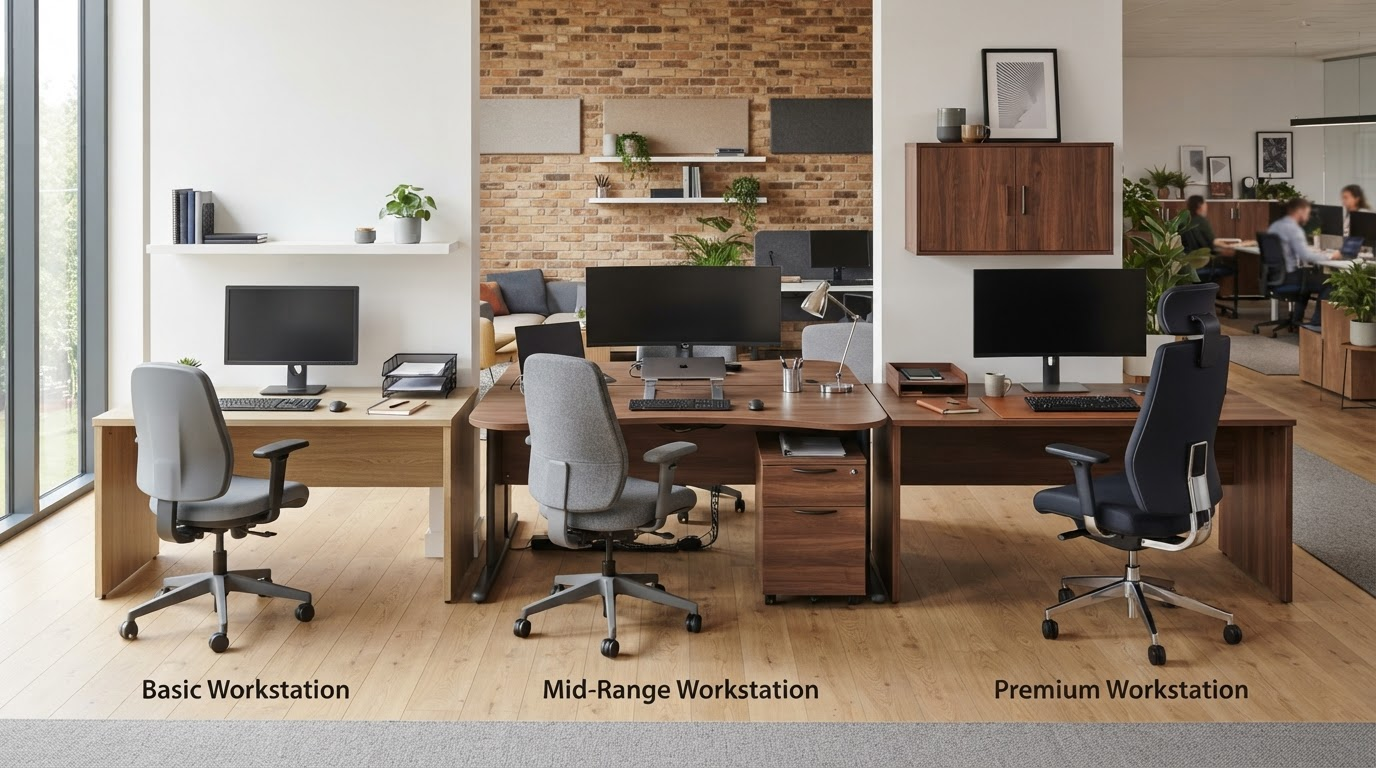
As a broad starting point, businesses can think about three levels of investment.

A basic furniture package focuses on essential functionality. It may include straightforward desks, practical office chairs and limited storage. This can suit a temporary workspace, a very small team or a business working with a tightly controlled budget.

A mid-range package offers a better balance between price, comfort, appearance and durability. It usually provides more choice in finishes, stronger construction and chairs designed for sustained daily use. For many established small businesses, this is where the best long-term value is found.

A premium package may include higher-specification ergonomic seating, executive furniture, bespoke layouts, coordinated finishes and furniture for reception, collaboration or breakout spaces. This level of investment is often appropriate when the workplace plays an important role in recruitment, client experience or brand positioning.

The right budget is therefore not necessarily the lowest one. It is the amount required to create a workplace that performs properly without paying for features the business does not need.

What Determines the Cost of Office Furniture?

The number of employees is an obvious starting point, but it does not tell the whole story. Two businesses with 20 employees can have very different requirements.

One may work almost entirely at individual desks. The other may need touchdown spaces, private offices, project tables, confidential storage and several meeting areas. The same headcount can therefore produce completely different furniture plans.

The size and shape of the building also affect the cost. Standard furniture may work perfectly in a simple rectangular office, while awkward corners, structural columns or limited access can require different dimensions and more careful planning.

The specification of the furniture matters too. Desks with cable management, height adjustment or integrated screening will cost more than basic fixed desks. An office chair designed for occasional use will normally cost less than one intended to support an employee throughout the working day.

Finishes, fabrics, warranties and expected lifespan all influence the final figure. Delivery and installation should also be included from the beginning rather than treated as unexpected costs at the end.

Office Chair Costs

Chairs are often the area where businesses are most tempted to reduce expenditure. They are also the items employees use most intensively.

A low-cost chair may be suitable for a meeting room or occasional workstation, but it may not provide the support, adjustment or durability required for full-time use. A task chair used for seven or eight hours each day needs to accommodate different body shapes and working preferences.

Useful features can include adjustable seat height, back support, armrests, seat depth and tilt resistance. Not every employee will need every possible adjustment, but the chair should be appropriate for how long it will be used.

It is better to assess chairs according to their cost over their usable life. A chair that costs less initially but requires early replacement—or contributes to discomfort and lost productivity—may prove more expensive than a well-specified alternative.

This does not mean every business needs the most expensive ergonomic chair available. It means the specification should reflect the user, the task and the amount of time spent sitting.

Desk Costs

Desk prices depend on size, construction, finish and functionality.

Straight desks remain a practical choice for many workplaces. Bench desk systems can use space efficiently and create a consistent appearance for larger teams. Height-adjustable desks cost more, but they provide employees with the option to alternate between sitting and standing.

The lowest desk price is not always the lowest project cost. An oversized desk can waste valuable floor space, while a desk that is too small may leave employees without enough room to work comfortably. Poorly planned desk positions can also create problems with power, data cables, circulation and future expansion.

Before choosing a desk, consider the equipment each employee uses and the tasks they perform. An employee working primarily from a laptop may need less surface area than someone using multiple monitors, paperwork or specialist equipment.

The aim is not to fit as many desks as possible into the office. It is to create workstations that use the available space intelligently.

Storage Costs

Storage is easily overlooked because it appears less urgent than desks and chairs. However, inadequate storage quickly leads to cluttered workstations, overflowing cupboards and inefficient use of space.

The cost will depend on whether the business needs personal storage, general office cupboards, filing systems, shelving or secure storage for confidential information.

Before ordering new units, review what genuinely needs to be stored. Businesses often discover they are keeping outdated paperwork, duplicate supplies or equipment that is rarely used. Removing unnecessary items may reduce the amount of furniture required.

Once the requirement is clear, storage can be planned as part of the overall layout. Well-positioned shared storage may be more useful than giving every employee an individual pedestal. Taller units can provide greater capacity without using much more floor area, although their positioning must be considered carefully.

Good storage is not simply about hiding things away. It should make frequently used items easy to access while keeping the workplace organised.

Meeting and Boardroom Furniture

Meeting spaces vary from informal areas used for brief conversations to boardrooms designed for presentations and important client meetings.

The cost will be shaped by the size of the room, the number of people it needs to accommodate and the impression the business wants to create. A small meeting table with four chairs is very different from a large boardroom installation with executive seating, power access and presentation facilities.

Buying the largest table that will physically fit is a common mistake. Employees must be able to move around the room comfortably, pull chairs away from the table and view screens without obstruction.

A well-planned meeting room may also reduce demand elsewhere in the office. If every conversation currently takes place at employees’ desks, providing an appropriate meeting space can improve concentration and reduce disruption.

The furniture should therefore be considered in relation to how the room will work, not just how it will look.

Reception Furniture

Reception furniture helps form a visitor’s first impression of the business. It must also provide a practical working environment for the employee using it.

A reception area may require a desk, task chair, visitor seating, occasional tables and storage. The cost can rise when businesses require a bespoke desk, coordinated finishes or furniture designed around a particular entrance.

The reception desk should not dominate the space or create an unnecessary barrier. It needs to accommodate equipment, paperwork and storage while allowing the receptionist to greet visitors comfortably.

Visitor seating should reflect how the area is used. A business where visitors wait for several minutes may need more supportive seating than one where guests are collected immediately.

A relatively small reception area can still look professional. Careful selection and positioning usually matter more than filling it with expensive furniture.

Delivery and Installation

Furniture prices are only part of the overall project cost. Delivery, assembly and installation should be considered during the budgeting stage.

A professional installation team can position furniture according to the agreed plan, assemble it correctly and remove packaging. This is particularly valuable when several rooms or a large number of workstations are involved.

Building access can affect the work required. Upper floors, narrow staircases, restricted parking and limited delivery times may all influence how an installation is organised.

There is also a cost to asking employees to build furniture themselves. Time spent assembling desks and moving heavy items is time taken away from their normal responsibilities. Incorrect assembly can shorten the furniture’s life and create avoidable safety concerns.

For a very small order, self-assembly may be reasonable. For a larger workplace project, planned delivery and professional installation usually provide a smoother result.

Space Planning and Furniture Consultation

Space planning can appear to be an additional expense, but it often prevents businesses from spending money on unsuitable furniture.

A plan helps establish how many workstations can fit comfortably, where storage should be positioned and whether meeting or collaborative areas can be accommodated. It also allows problems to be identified before products arrive.

This becomes particularly important when a business is growing. Furniture selected only for today’s team may make future expansion difficult. A more flexible layout can allow additional employees to be accommodated without replacing everything.

Consultation also helps separate genuine requirements from assumptions. A business may believe it needs more floor space when the real problems are oversized desks, inefficient storage or a poorly organised layout.

The objective is not to sell the greatest possible quantity of furniture. It is to make sure the furniture purchased supports the way the business operates.

Why Cheap Office Furniture Can Become Expensive

Price matters, particularly to a small business, but purchasing decisions should also consider lifespan, maintenance and employee use.

Low-cost products are not automatically poor value. They can be entirely appropriate for temporary spaces, occasional users or areas with limited use. Problems arise when furniture designed for light use is expected to withstand the demands of a busy workplace.

Replacing a desk or chair sooner than expected adds another purchase, another delivery and more disruption. If several items fail at different times, the office can gradually become a mixture of unrelated styles and specifications.

The same principle applies to employee comfort. Furniture that cannot be adjusted properly may not support the range of people using it. A slightly higher initial investment in suitable task seating can provide better value than repeatedly replacing inadequate chairs.

Value should therefore be judged over the expected life of the furniture, not only at the point of purchase.

Setting a Realistic Furniture Budget

Start with the business requirement rather than a product catalogue.

Establish how many employees need permanent workstations and how many work flexibly. Consider whether private offices, meeting rooms, reception areas or collaborative spaces are required. Review the storage currently used and decide what still needs to be retained.

Next, separate essential items from desirable additions. Appropriate desks and task chairs may be essential, while a breakout area could be introduced during a later phase. This protects the quality of the items employees use most rather than spreading the budget too thinly.

It is sensible to retain a contingency for changes discovered during planning or installation. Access issues, additional storage requirements or changes to power and data positions may affect the project.

Most importantly, compare quotations on a like-for-like basis. A lower figure may exclude delivery, installation or services included elsewhere. Product warranties and specifications may also differ significantly.

A clear quotation should explain what is being supplied, what services are included and how the proposed furniture meets the brief.

Should You Replace Everything at Once?

Not necessarily.

If some of the existing furniture remains suitable, it may be possible to incorporate it into the new plan. This can reduce cost and waste, particularly when desks, storage units or meeting furniture are still in good condition.

However, retaining furniture simply because it already exists can limit the new layout. Oversized desks or mismatched storage may prevent the office from using space efficiently.

A phased approach can work well when the business needs to control cash flow or minimise disruption. Priority might be given to unsuitable chairs and damaged workstations before meeting rooms or reception areas are updated.

The important thing is to plan the phases together. Without an overall direction, separate purchases can create an inconsistent workplace and make later improvements more difficult.

Plan Before You Purchase

Office furniture is a significant investment, but it should not begin with a shopping list.

It should begin with an understanding of your people, your space and the way your business works. Once those requirements are clear, furniture can be selected with a purpose.

At Lomas Office Furniture & Stationery, we help businesses across Blackburn and Lancashire plan practical workplace furniture solutions. From office chairs and desks to storage, reception areas and boardrooms, we can help you understand the available options and develop a solution suited to your requirements and budget.

If you are planning new office furniture and would like a clearer idea of the likely investment, speak to our team to arrange an office furniture consultation.

Frequently Asked Questions

How much does it cost to furnish a small office?

The cost depends on the number of employees, the furniture specification and whether the project includes meeting rooms, storage, reception furniture, delivery or installation. A consultation and space plan will provide a more reliable estimate than a general cost per employee.

What should I spend the most money on?

Prioritise the furniture employees use most frequently. For many businesses, this means suitable task chairs and appropriately sized desks. Storage and meeting furniture should then be planned around operational requirements.

Is ergonomic office furniture worth the additional cost?

It can be, particularly for employees who spend much of the day at a workstation. The important factor is not the label “ergonomic” but whether the furniture provides useful adjustment and is suitable for the employee and their work.

Can existing furniture be reused?

Yes, provided it remains safe, functional and compatible with the proposed layout. Existing items should be reviewed during planning rather than automatically retained or discarded.

Does office furniture installation cost extra?

This depends on the quotation. Some suppliers show delivery and installation separately, while others include them within the project price. Always confirm what is included before comparing proposals.

Can office furniture be installed in phases?

Yes. A phased installation can help manage budgets and reduce disruption. The entire project should still be planned at the outset so that each phase works as part of a consistent long-term layout.

We are using cookies to give you the best experience. You can find out more about which cookies we are using or switch them off in privacy settings.
AcceptPrivacy Settings

GDPR